
Stop blaming bad luck: The real reason Ultimate players keep straining their hamstrings.

Ultimate frisbee and hamstrings strains are an infamous duo. They unfortunately seem to go hand in hand and should we go around the room I think most people here have been affected by a hamstring strain from ultimate frisbee (Pulido, et al, 2020). A hamstring strain is the most common non-contact muscle injury in high-speed running sports which is why we see it so often in ultimate frisbee.
What's a hamstring?
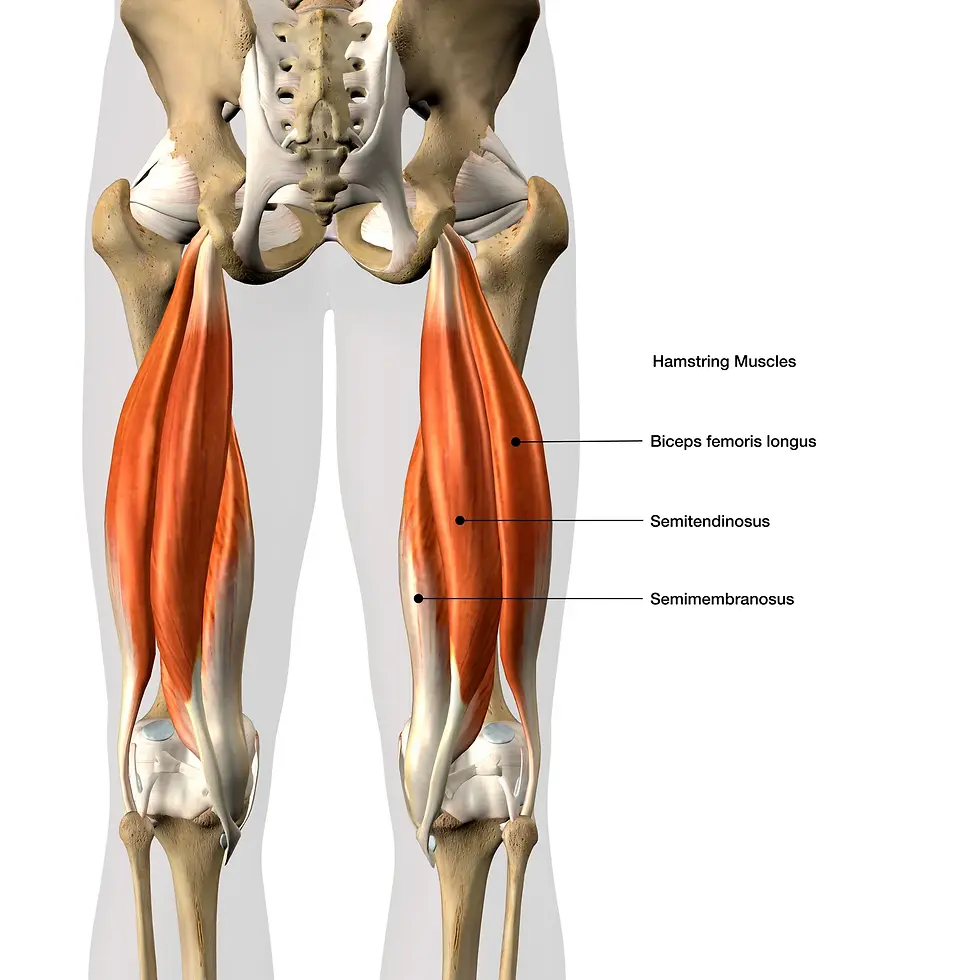
Your hamstrings are a group of muscles at the back of your thigh: biceps femoris, semitendinosus, semimembranosus. They cross the hip and knee and they help you:
extend your hip (drive you forward)
flex your knee (bring your heel up)
control your leg as you sprint and brake
What is a muscle strain?
A strain is a tear in the tendon or muscle fibres commonly from overload. For interest's sake, a sprain is a ligament tear (Yu, 2017).
Ultimate is basically a perfect storm for hamstrings: repeated sprints, hard decelerations, sharp cuts, awkward layouts, and playing while tired.

"You asked for more than your hamstrings are prepared for."
You get two specific hamstring injury types:
Stretch-type: the hamstring injury occurs in movements involving a combination of extreme hip flexion and knee extension. This basically put the hamstring in its most lengthened position, known as an eccentric load (Yu, 2017).
Think overstriding, reaching low and long for the disc, layouts or slipping on wet grass. This often feels like a sharp pull in the back of the thigh.
Sprint-type: this injury occurs during maximal running actions. This also a very high eccentric demand where there is high load in the lengthened muscle (Yu, 2017).
This often happens in quick acceleration from zero, sharp changes in direction or sprinting when fatigued, like the last day of a tournament. It feels like a sharp ‘grab’ at the back of the thigh.

This strain can be of varying degrees of damage:
Grade one: minimal fibres are affected, resulting in a mild injury.
Grade two: moderate fibres are affected, resulting in more muscle damage and pain.
Grade three: muscle fibers are disrupted and/or pulls away from the tendon. This is a severe and dangerous injury.
A hami strain doesn’t just happen, there is a lot brewing prior to the injury.
Firstly, are your hamstrings very tight and lack range of movement? This lack of extensibility can put you at risk of a stretch type injury, where you extend the muscle past its available range and it tears (Liu, 2017).
You asked for more speed than your hamstrings are prepared for. High-speed running is a different beast than jogging conditioning. If your body hasn’t been exposed to regular max-velocity and eccentric strength at long lengths, it's not fitness you’re missing, it’s the capacity (Wilmes, 2021).
Ultimate isn’t only sprinting, it’s deceleration. Hard braking and re-acceleration stack fatigue and force demands across a point which can result in a strain (Wing & Bishop, 2020).
Hamstrings don’t work alone. If your pelvic/trunk control is inefficient, hamstrings often end up doing extra stabilizing while also trying to sprint (Wing & Bishop, 2020).
Strains beget strains. Prior hamstring strain is one of the most consistently reported risk factors for another one with the risk being three times worse than an individual who has not had a prior strain (Wing & Bishop, 2020).
We get warning signs!
A prelude to a hamstring strain is fatigue in the leg and a cramping feeling in the back of the thigh. If you don't normally get cramps, specifically in that area, it is a sign to get off the field. Rather be safe than sorry. A ‘pre-strain’ cramp like feeling is a lot easier to deal with than the 4-6 week long rehab process of a hamstring strain.
The good news is that most of the biggest risk factors are trainable. We want to build long-length hamstring strength, expose your body to progressive sprint work, and develop repeat-effort conditioning so your mechanics are fired up and ready to go, no matter if it’s the start of the game or three days into a tournament!
Want to know how to bulletproof your hamstrings?

Stay tuned for practical, at-home plans you can plug into your week to keep your hamstrings resilient and game-ready.
-Ally Smith
References
Pulido, D. F., et al. (2020). Epidemiology of Injuries in Ultimate (Frisbee): A Systematic Review. Sports Health. (PMCID: PMC7767421).
Khoo, K. J., et al. (2021). Characterization of Injuries in Male and Female Ultimate Frisbee Players. (PMCID: PMC8016424).
Marfleet, P. (1991). Ultimate injuries: a survey. (Europe PMC record).
Yu, B., Queen, R. M., Abbey, A. N., Liu, Y., Moorman, C. T., & Garrett, W. E. (2017). Mechanism of hamstring muscle strain injury in sprinting. Journal of Sport and Health Science. (PMCID: PMC6188997).
Liu, Y., et al. (2017). The late swing and early stance of sprinting are most hazardous for hamstring injuries. (PMCID: PMC6188991).
Wilmes, E., et al. (2021). Associations between Hamstring Fatigue and Sprint Kinematics… (PMCID: PMC8594518; PubMed record also available).
Wing, C., & Bishop, C. (2020). Hamstring Strain Injuries: Incidence, Mechanisms, Risk Factors, and Training Recommendations. Strength and Conditioning Journal.
Edouard, P., et al. (2018). Sprint Acceleration Mechanics in Fatigue Conditions… Frontiers in Physiology.
Huygaerts, S., et al. (2020). Mechanisms of Hamstring Strain Injury: Interactions between Fatigue, Muscle Activation and Function. Sports (MDPI).


Comments